
Whether you want to buy a brand new piano, upgrading your current one or looking for a decent piano to start your musical journey, please read on. A free piano is rarely free in the long run and may translate to ‘Please remove my unwanted, unused and neglected piano for nothing.’
Have you factored in moving costs, the likely servicing and tuning costs too? It is often a good idea to spend a little bit on the piano and find a reputable dealer. I sometimes have pianos for sale, and they are always good quality and have had a thorough inspection, regulation and tuning.
Types of Piano Construction
I’ll start with things you should avoid as this is the most important part of buying a piano. Of course, it is always advisable to send me photos/video or, even better, have me accompany you to the piano which you are thinking of buying. The main things to avoid is a piano over 100 years old, unless it has been restored, recondition or refurbished (some old pianos can be beautiful if well maintained). Generally a piano older than 100 years is worth buying if it is a well known make, but some lesser known brands can be great too. The problem with an older piano is the strings and soundboard may be tired, have lost their resonance and the sound is dull, ‘tubby’ or harsh. This could also mean there are issues with the action (basically the engine of the piano).
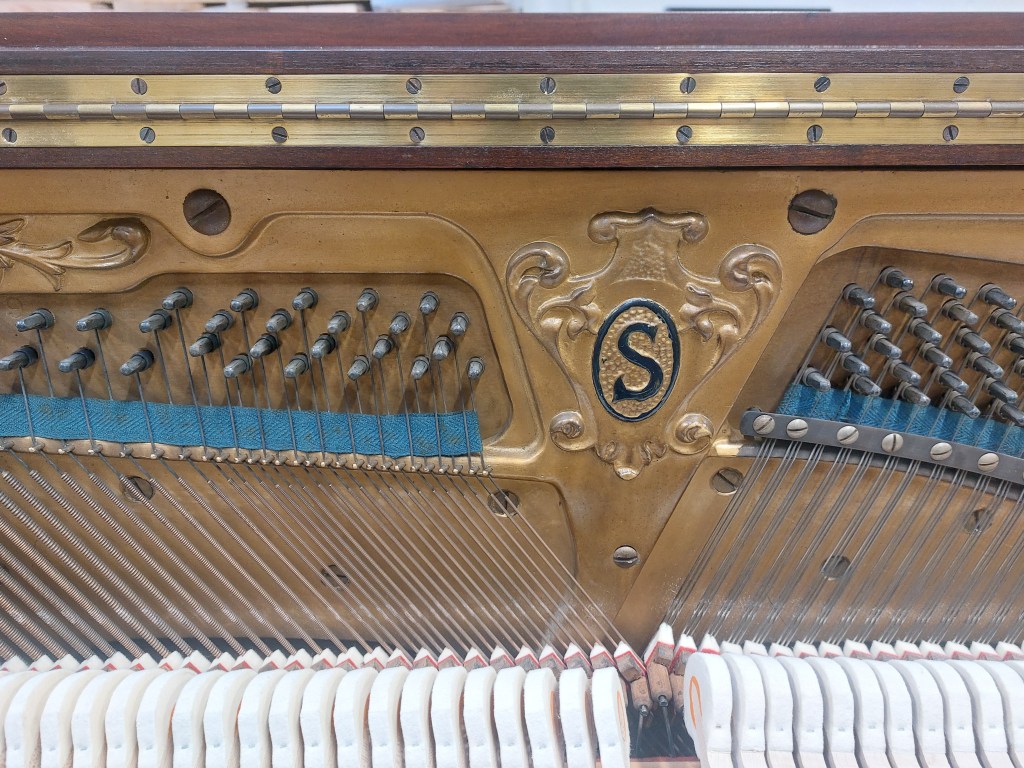
For upright pianos it is advised to avoid overdamper actions (OD) and ones which are straight strung (SS). The overdamper action is one where the dampers (the pads which mute the strings) are above (or over) the hammers. These actions don’t play well and are noisy compared to an under damper action (dampers under the hammers). If you look in the top of the piano you should be able to clearly see all the hammers. If not, walk away.


Straight stringing is when the bass strings go straight along the length of the piano instead of crossing over the treble strings. All strings run parallel to each other. This can be seen in the image below, left. Most over dapoers are straight strung.
Over stringing (sometimes called cross stringing) means the bass strings go at an angle and cross over the tenor strings. The bass strings in over dampers are longer and, because they are closer to the tenor and treble, they assists in the treble strings vibrating in sympathy, giving a richer tone. More importantly, the bass strings are longer and thus sound richer in themelves. You can see on the image below right, the bass and tenor strings crossing each other.

Upkeep and Environment
‘Not been tuned in many years’ is something I hear a lot and it makes me worry. This means that it hasn’t been serviced and has been neglected and innevitably needs a lot of work. Ask the seller about the piano’s service history. If they don’t know abything about it, proceed with caution. It also worrys me when I see such a thing on an instrument which is ‘Ideal for beginners’. This may be translated as ‘not very good’. A neglected and poorly maintained piano will do nobody any good. If the piano is rubbish it will be uninspiring to play and whats worse will limit the ability of the pianist to improve. It is worth spending a bit extra and it will then at least likely keep some resale value.
Check the environment the piano is in. Is the room damp, is it a conservatory (proceed with extreme caution if so), is it next to a radiator? Also ask why the person is selling it.
In Conclusion
Find out as much as you can about a piano’s history. Only consider over strung, under dampered pianos. Get me to have a look over it. I don’t charge to look at photos, and paying for my time to inspect it in person will ensure you will get a piano to suit your means, and you won’t get a junk piano. On that, the best advice is to get the biggest, most expensive piano you can afford. The footprint of a small piano is not usually that much smaller than a tall piano.
 Legacy Piano Services