
The piano action is the name given to all of the mechanical parts which connect the key to the hammer hitting the string. It consists of three main assemblies: the lever, the hammer and the damper. There is one of each for every note. There are around 12 000 individual parts in a piano, 10 000 of which are moving parts. Because there are so many moving parts it is important to get your piano regulated (the process of adjusting and maintaining various parts of the action).
The Key and the Lever
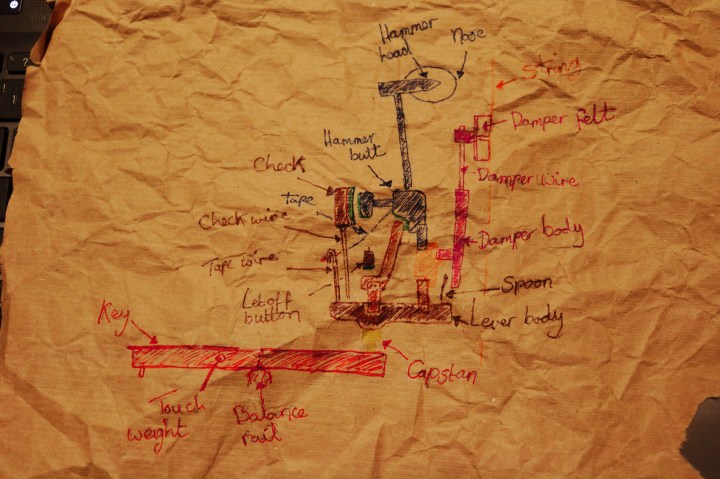
The key is a logical starting point for describing the movement of the action. When you look at a piano keyboard you only see 1/4 to 1/3 of the total length of the key. It is balanced in the middle on a fulcrum (the balance rail). There are usually touch weights in the key to give the right feel and to counter some of the weight of the action. At the back of the key is the lever which sits on a capstan. When the key is pressed the lever body moves upward and the jack pushes the hammer butt, moving the hammer towards the string. If you play the key slowly you will notice there is a click and the hammer falls before it hits the string. This is called let off and is one of the reasons a piano can play soft or loud depending on the key strike (this was referenced in a previous blog post ‘About the Piano’). As the hammer hits the string the check catches the hammer and stops it bouncing wildly. Correct checking distance will assist repetition; if it is too small the hammer may block the string. The lever also controls the movement of the damper as the spoon engages with the damper tail. The spoon can be regulated to make the dampers lift earlier or later. The later the lift, the lighter the touch and vice versa.
When the key is released the lever falls and the jack spring returns the jack to the rest position under the notch in the hammer butt. As the lever falls the tape is tugged back which assists in the hammer returning faster.
The Dampers
As noted above, the dampers are cleared from the strings by the spoon. The spoon is adjusted backwards or forwards to regulate the optimum time for the damper to move. The dampers must also be regulated to move together when the damper pedal is pressed. This is done at the damper wire. To get it perfect is a long and involved process, believe me! The wires are also bent to ensure the dampers sit squarely on the strings and don’t interfere with adjacent strings. Sometimes a flying damper is found where the bass and tenor strings cross. This is to assist the damping of the longer tenor strings, which due to the crossing of strings the regular dampers need to be smaller. The dampers are returned to the rest position when the key is released by the damper spring.
The Hammers
The hammer is flung at the string by the jack. Because the sound in a piano is made by hammers hitting a string, the piano is technically a percussion instrument. The distance between the hammer nose to the string is called the blow distance. The distance of the blow can be adjusted, but around 45mm is a good starting point. The hammer felt can be voiced to make the tone louder, softer, mellower or brighter. When the key is released, as well as the tape pulling the hammer back, there is a spring attached to the hammer butt and to a loop of string attached to the flange.
The left hand pedal on an upright pushes the hammers closer to the string. This reduces the blow distance so will assist quiet playing. As a result of the hammer being closer to the strings, the touch will also change – it will become lighter.
A Brief Look at the Types of Action
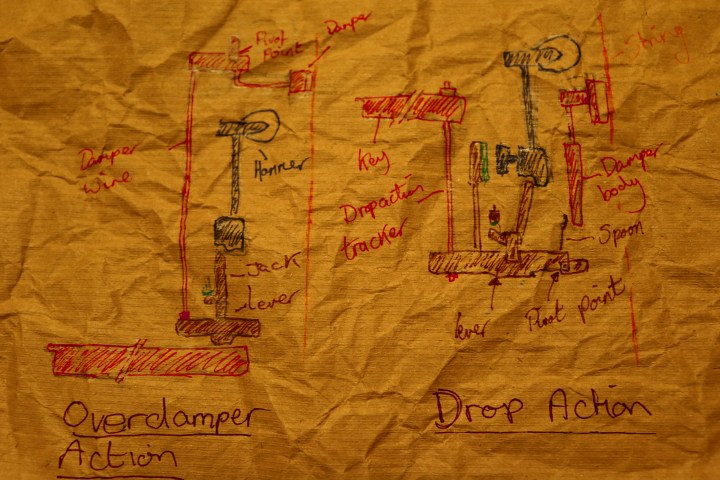
There are a number of different types of action in the upright piano world. There is over damper, where the dampers are above the hammers. This type of action is obsolete now and because the dampers are placed so high on the string, the strings ring on after the key is released. If you are serious about your piano playing it is advisable to not get an over damper. The most usual type of action is the under damper, where dampers are below the hammers. Because the dampers are further down the string they mute the strings a lot better. Finally, another type of action is a drop action. This is found in small pianos where the action is placed lower than the keyboard. Notable pianos with these are Evestaffs and the Kemble Minx. These drop action pianos are good if you live in a hobbit hole but it is always advisable to get the biggest piano you can afford. The bigger the piano the better the sound. Types of pianos will be a discussion for a later post. This will focus on what to look for when buying a piano.
For further reading have a look at the Wikipedia page on the piano action. There is also a detailed video on YouTube
 Legacy Piano Services
One thought on “The Piano Action (Upright)”