
This post introduces a little about pitch, what it is and why you should care. It will give a general overview of the science and technical bits to start. The next part will discuss the relevance of pitch to your needs, before concluding with a little more general information about how pitch relates to the piano.
What is pitch?
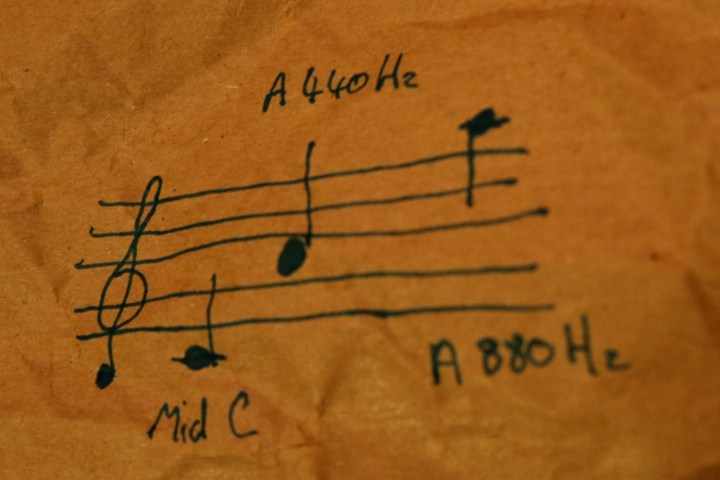
Pitch is the frequency of the sound when you play a note. It is expressed in Hertz (Hz). Standard tuning/concert pitch puts A above middle C on the piano at 440 Hz (the string vibrates 440 times a second. It may also be referred to as cycles per second). The higher the frequency, the higher pitch of the note. If a piano’s tuning is flat (maybe A has a frequency of 435Hz) the pitch may need to be raised. A piano is generally designed to be at A 440Hz and will therefore perform best at this frequency – it will certainly sound better. If you double the pitch, you create an octave. The A above vibrates at 880Hz.
What relevance does pitch have to you?
It may be that you don’t need the piano to be at pitch – these circumstances are limited though. For example you may not allow anybody to hear you playing (I fall into this category) and you only ‘mess around’ on the piano. However, if you want to accompany other musicians, accompany yourself singing or play your favourite tunes, it is a whole lot easier at the correct pitch. Also, if your children are the main pianists in the house, it is vitally important to give them the best start in music and to lock the correct pitches in their head from the outset. Perfect pitch (being able to name a note when you hear it) is somewhat learnable. It’s not necessary though, the most important thing is to play what you like and to enjoy it.
Pitch and the piano
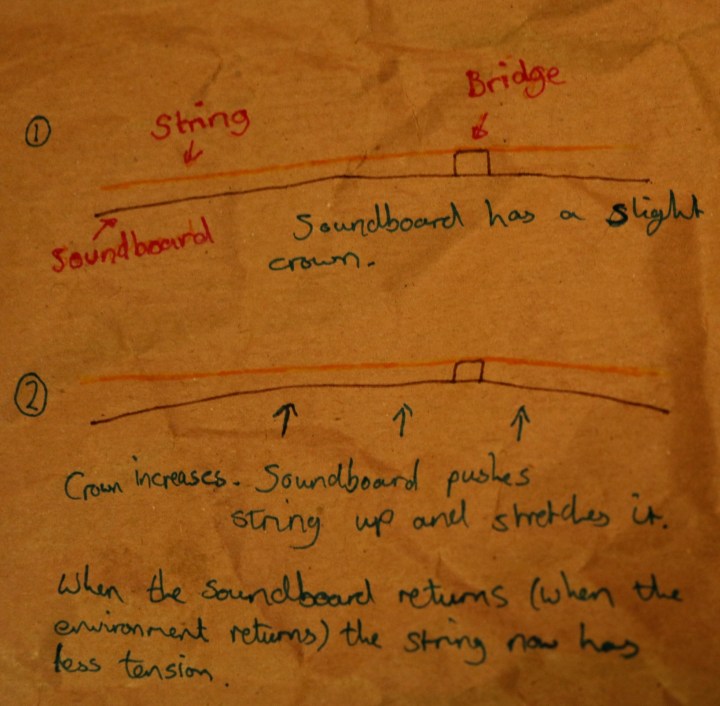
It is common for a piano to fall in pitch as the tension on the strings decrease (a single piano string can have 18-30 tons of tension depending on the piano!). A fall in tension can be caused by the wooden parts of the piano, especially the soundboard, swelling and shrinking over the course of the year, or as the temperature in the house changes on a daily or weekly cycle. As the soundboard swells it forces the strings up, stretching them; then when the soundboard relaxes, the strings return to their starting position but is a little slacker. The slacker the strings, the lower the pitch.
Although you may not hear the gradual pitch fall, once the piano is tuned back to A440 it is amazing to hear the difference – it will sound brighter and cleaner.
Not all pianos are capable of achieving 440Hz. If the piano is old, with loose tuning pins and/or has rusty strings, it may be advisable to keep it at its current pitch or to get it as close as is possible to A440.
You can find out the pitch of your piano by downloading a free tuning app and playing the A above middle C and check where the needle lands (note, since there are three strings per piano note, if these strings are out of tune with each other the needle may struggle to settle. It is not advisable to tune your own piano using an app as it is not generally accurate in the top treble and bottom bass. Nothing matches a well-trained human ear. Furthermore the temperament (more on this in a future post) may not work out on a digital tuner. Good tuning apps are Cleartune or G Strings (honestly).
This is by no means a full discussion on pitch. I’ve not even mentioned the use of A442 or higher on the continent, or 435 in Cuba (so strings would last longer because they are so hard to get hold of). Nor have I mentioned the usual accepted baroque tuning pitch. This is a topic I love to dive into so please add comments or ask questions. I will be more than happy to help you, or at least point you in the right direction.
 Legacy Piano Services
One thought on “A word on Pitch”